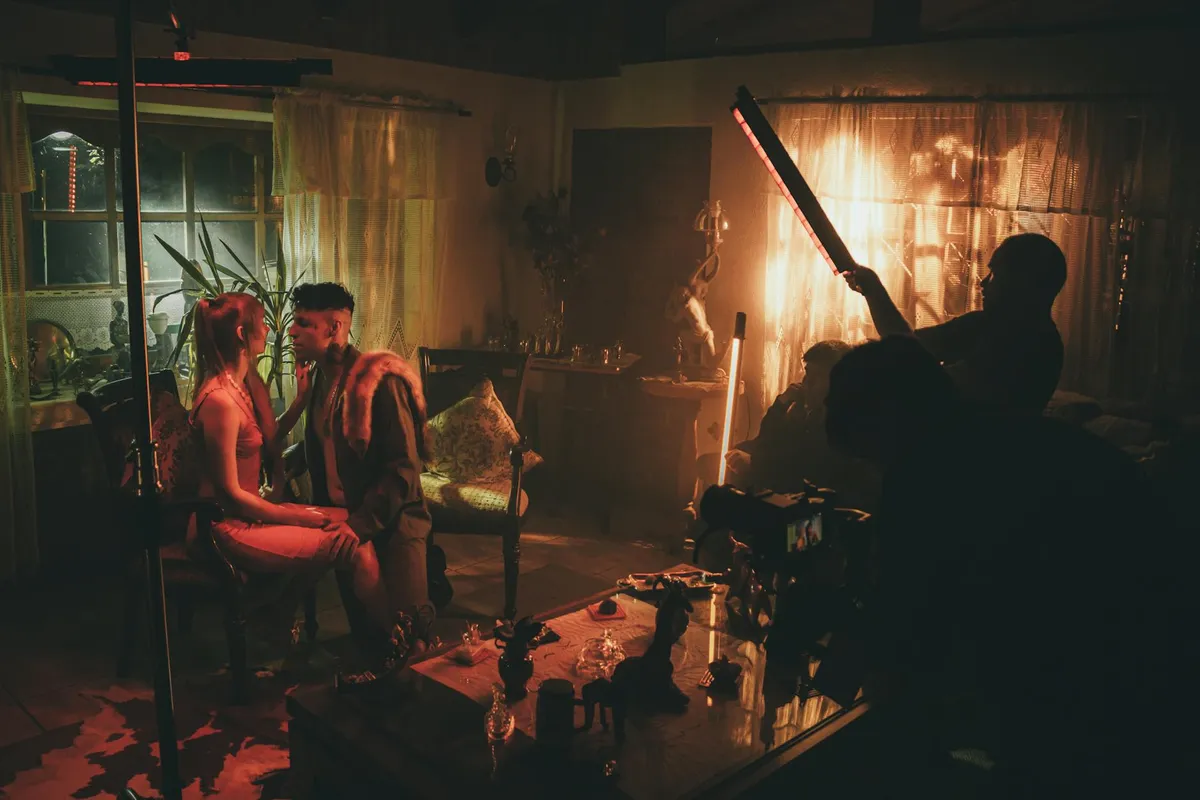
Cinematography breakdowns work better when they're specific. "It looks moody because they used soft light" is useless. "They used a 4x4 Kino through a quarter grid four feet from her face, with negative fill on the off-camera side, and a small backlight kicker from a 100w fresnel two stops down" is specific.
Here are six specific scenes from films most working DPs have seen, broken down by what was actually done. The budgets behind these scenes are large in some cases. The patterns are useful regardless of budget.
1. The dinner scene from a contemporary award-winning narrative film
What you see: A small dinner table, three characters in conversation, naturalistic warm lighting, soft falloff into shadow.
What was actually done:
The room's practical fixtures (a hanging pendant lamp over the table, a small wall lamp behind one character) were dimmed to provide ambient warm wash without being the actual key.
The actual key was a 4x4 Kino with full grid two feet outside the window pretending to be late afternoon light, gelled to match the practical color temperature.
Fill came from a large 12x12 silk reflecting back the key with a 3/4 stop down, giving wraparound on faces.
The "shadow falloff" was a deliberately negative-filled perimeter — black flags around the actors capping the light wrap.
Camera was a wide-open T1.4 prime, slight overexposure of skin to produce the warm-light feel.
What you can take from it: The "naturalistic look" has substantial artifice behind it. The practicals look like the source; the actual light is specifically crafted to look like the practicals.
2. The car interior scene from an action-adjacent narrative film
What you see: A character driving, day exterior visible through the windshield, faces lit but dimensionally rather than flat.
What was actually done:
The car was on a process trailer with a green-screen wrap (the exterior was added in post).
The "sun" was a 4K HMI rigged on a stand keeping consistent angle relative to the car as the trailer moved.
Bounce came from a beadboard rigged below the dashboard, giving warm fill from below that mimics what a car interior actually does.
A small kicker came from a tube light hidden in the door panel, giving edge to the actor's face that pure key wouldn't produce.
Camera was rigged to the trailer with multiple positions covered.
What you can take from it: Car interiors look "natural" through specific artifice. The bounce from below and kicker from the side reproduce what real cars do; the sun keeps consistent angle through process work.
3. The dimly-lit interior interrogation scene from a thriller
What you see: One character backlit and shadowed, another character partially illuminated, deep shadows throughout.
What was actually done:
The "ceiling fluorescent" practical was actually a Kino bulb in a custom housing dropped into the ceiling fixture, giving controllable intensity and color.
The light from above the back-lit character was an aggressively dimmed Source Four with deep gobos creating broken-light pattern on the back wall.
The light hitting the front character was a small LED panel four feet away with diffusion, but flagged so only specific parts of the face received light.
Negative fill was extensive. Black duvetyne flagging cut off all wraparound that would have softened the look.
Camera was at T2 to maintain depth in the shallow available light, with specific lens choice to maintain falloff in skin tones.
What you can take from it: The dim look is specifically crafted, not just "shoot in a dark room." Each light source is precisely shaped; each shadow is intentional rather than absence-of-light.
4. The exterior magic-hour scene from a romance film
What you see: Two characters at sunset, faces illuminated by warm light, beautiful background falloff.
What was actually done:
The actual sunset window for shooting was about 25 minutes. Setups were planned to get specific shots within that window.
The faces were lit by a 4x4 silver bounce reflecting the actual sunset light, giving warm wraparound that pure sun couldn't provide.
Backlight was the actual sun for those few minutes when the angle was right.
Background separation came from haze (atmospheric effect) introduced via fan-blown smoke just behind the characters but out of frame.
Camera operator pre-blocked exact positions so the limited window could be used efficiently.
What you can take from it: "Magic hour" requires substantial planning and substantial preparation to capture in the actual brief window. The romantic look depends on the bounce work, not just the available light.
5. The horror reveal scene from a contemporary horror film
What you see: A character moves slowly through a dark space; a sudden specific source illuminates something terrifying.
What was actually done:
The "ambient darkness" was lit at very low key — specific Kinos at one-quarter power providing just enough ambient to keep camera operating without being visible.
The "source" of the reveal was a moving Source Four LED with a specific gobo, controlled by a board operator timing to the action.
The "terrifying thing" was lit with a tight-spot Source Four hitting only specific elements, with substantial negative fill cutting any softening of the hard light.
The character's movement was choreographed precisely to specific lighting cues. Walk three steps; light shifts; turn; the source illuminates.
Camera was wide open with substantial film grain emulation in post to maintain shadow detail without losing the lurking-darkness texture.
What you can take from it: The "horror tension" is musical. The lighting cues and the movement are choreographed together. The horror is specifically constructed rather than improvised.
6. The action reveal from a major action film
What you see: A character walks into a space; the space "lights up" as the character enters.
What was actually done:
Practicals throughout the space were on a board controlling each separately.
The board operator was rehearsed precisely to actor movement. Walk five steps; lights one through three come up. Turn; lights four through six come up. Move; ambient practical wash comes up to full.
The "lighting reveal" was actually a programmed sequence of specific fixtures rising at specific moments.
The actor was operating in a darkened space. The lights coming up changed the actor's actual conditions in real time.
Camera moves were similarly programmed to specific moments — wide as the space reveals, push in as the action begins.
What you can take from it: The "lights come on" action moment is precisely choreographed. The actor, the lights, and the camera all hit specific marks at specific times. The result feels organic but is mechanical underneath.
What the breakdowns reveal
Across the six scenes, certain patterns emerge:
Lighting that looks naturalistic is rarely natural. The "practicals are the key" model is almost always actually "practicals plus carefully placed cinema fixtures providing the actual key, gelled to match the practicals."
Negative fill is as important as positive fill. The black flags shaping where light doesn't go are as carefully placed as the lights themselves.
Pre-planning is substantial. Each of these scenes involved tech scouts, lighting plots, and rehearsal that took longer than the actual shooting time.
Camera and lighting are integrated. Camera position determines what lighting works; lighting determines what camera positions are viable.
Actor positioning is part of lighting. Performers hit specific marks that allow specific lighting to function. Performance and lighting are not separate departments in the actual on-set work.
What productions at lower budgets can take from this
The specific equipment in these breakdowns may not be available at lower budgets. The patterns nonetheless apply.
What translates:
The pattern of practicals plus carefully placed cinema fixtures works at any budget. The cinema fixtures might be Aputures rather than ARRI; the principle holds.
The negative fill principle works regardless of light source. Black foamcore from a hardware store flags off light for ten dollars.
The pre-planning principle scales down. A small production can plan substantially on the day before; the discipline matters even at small scale.
The integration of camera and lighting works at any scale. Independent productions that integrate these effectively look better than higher-budget productions that don't.
The marker-based actor blocking works regardless of crew size. Tape on the floor and clear communication produce hit-the-mark performance.
What watching cinematography critically does
Watching films with attention to specific lighting choices builds visual literacy.
What develops over time:
Recognition of light direction. Where the light comes from in any specific shot.
Recognition of light quality. Hard versus soft, specular versus diffused.
Recognition of color choices. The specific palette decisions and how they're executed.
Recognition of negative fill. Where light is being kept out.
Recognition of patterns. Common solutions to common problems across films.
Recognition of distinctive choices. What specific cinematographers do that distinguishes their work.
The recognition is craft knowledge. It develops through accumulated attention.
What I tell prospective cinematographers
For DPs developing their craft:
Watch films with attention to specific lighting and camera choices. Generic watching doesn't develop the vocabulary.
Read shot-by-shot breakdowns when available. American Cinematographer publishes substantial detail on specific productions.
Try to recreate specific looks on small projects. The recreation reveals what the original involved.
Watch with other working cinematographers when possible. The conversations during and after develop understanding.
Build a personal reference library of specific scenes you find compelling. Return to them across years.
The craft develops through this work. Talent matters but craft matters more across years of working.
The honest takeaway
Cinematography is craft. The craft is specific. The specific choices in any given film are not random; they're the result of substantial planning and execution by skilled crews.
Breaking down what specific scenes actually involved demystifies what often looks magical. The magic comes from craft applied with discipline. The discipline can be learned.
The six scenes above all involved substantial planning, substantial crew coordination, and specific technical choices. The patterns translate across budgets even when the specific equipment doesn't.
For working cinematographers: study scenes specifically. Recreate the patterns. Build the vocabulary. The craft develops through this work.
For viewers who want to understand cinematography better: watch with attention to where the light comes from, what direction it falls, where shadows are, where they're not, how the camera position relates to the lighting.
The vocabulary develops. The pattern recognition develops. The appreciation of what skilled cinematography involves develops.
That's how the trade gets understood from outside, and how it gets practiced from inside.